

The Sacred Love Story of Control

The Edge
It starts as a ripple.
A tightening in your chest.
A thought you can’t finish.
A wave of heat that rises fast and pulls your shoulders up with it.
You want to move.
Say something.
Fix it. Leave!
Control something — anything — so you don’t have to feel this.
So you don’t have to sit here…with your self.
Your mind spins fast.
Your breath goes shallow.
Your body is loud and quiet at the same time.
Everything in you wants out.
The Escape Plan
You open your mouth.
Reach for your phone.
Go clean something.
Scroll.
Distract.
Disappear.
Explain.
Make it make sense.
It looks like productivity.
Or anger.
Or numbness.
It looks like being “fine.”
But really, it’s just your system trying to escape the thing you’re not ready to feel.
You’ve done it before. We all have.
The Moment You Stay
But what if you didn’t do all that?
What if you didn’t abandon yourself this time?
What if you didn’t shame the feeling?
Or try to understand it?
What if you didn't make it about anyone else?
Like if you could just stay?
Right there.
Inside your body.
With the pounding, the heat, the ache, the pressure.
What if you could feel it —
without letting it control you,
and without trying to control it?
What Sacred Control Really Is
Sacred control isn’t about tightening up.
It’s not discipline.
It’s not perfection.
It’s not shutting it all down.
It’s presence.
It’s the breath you take instead of the sentence you regret.
The silence you keep that doesn’t choke you —
because you’re still there, holding yourself.
It’s a boundary you keep within yourself.
You don’t lash out.
You don’t leave.
You don’t rush to fix.
You stay soft when everything in you wants to harden.
That’s control.
Not over the feeling —
but over the part of you that’s always trying to run from it.
Why We Control
We don’t control because we’re rigid or broken.
We control because, at some point, it kept us safe.
As children, we needed someone to step in in a certain way.
And when that person wasn’t there — or couldn’t do what we needed —
we filled the role ourselves.
The protector.
The fixer.
The one who stayed calm, quiet,
and made everything okay — even when it wasn’t.
That role helped us survive.
But most of us never updated it.
So now, as adults, we still perform the version of protection we needed then —
instead of offering the kind of holding we need now.
We don’t know how to be with what’s happening.
So we manage it.
We interpret it.
We try to control the next moment so it doesn’t feel like the last one.
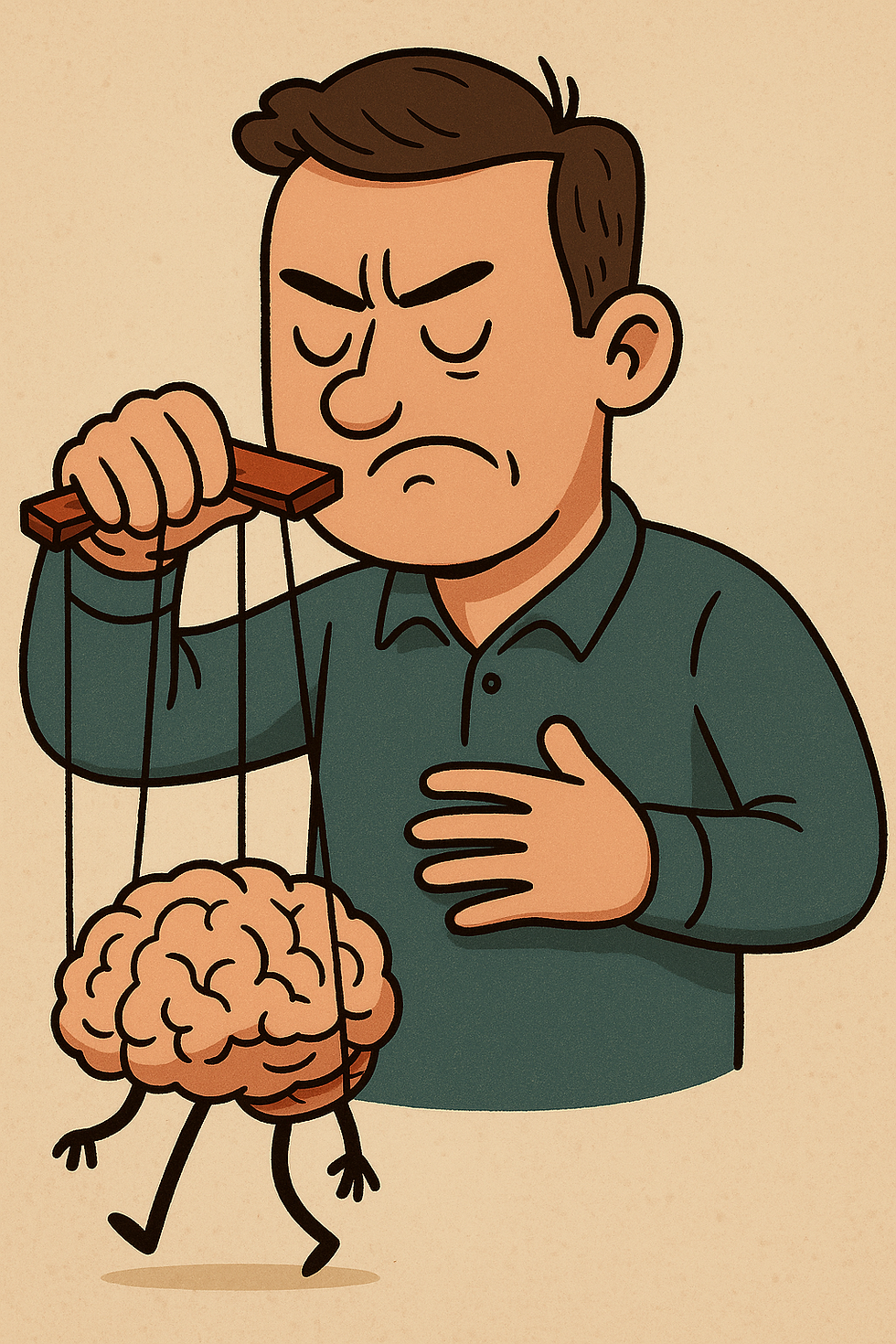
Don’t trust the story your mind writes about your feelings.
It’s not the truth.
It’s a defense.
Your mind attaches feelings to stories.
It tells you: Because I feel this again, it means this is about to happen again.
So you control.
You perform.
You retreat.
You explain.
You try to manage what’s coming —
because your body remembers what already came.
And if you don’t get ahead of it…you’ll end up back where you were:
small, powerless, unprotected.
But what you’re actually protecting isn’t your future.
It’s your story.
The one you built to explain your pain.
The one that made the chaos make sense.
If you couldn’t have peace, at least you had a reason.
And now, that story has become your identity.
Letting go of it feels like death.
Because it was the only thing that held you when no one else did.
But your story is not your Self!
It was scaffolding — not structure.
A survival map — not a home.
You don’t need to destroy it.
You just don’t need to live by it anymore!
Sacred control is what lets you loosen the grip without falling apart.
It’s what lets you feel something new without needing it to match what came before.
It’s what allows you to become something new.
Your Miasm Is Showing
Psora: You feel the rise of emotion and immediately try to fix it. You self-improve. You start journaling your way out before you’ve even felt your way in.
Sycosis: You perform. You hide what’s real under a mask of humor, charm, guilt, or apology. You turn it inward and pretend nothing’s wrong.
Syphilis: You self-destruct. You lash out, collapse, or spiral into doom thinking. You try to destroy the emotion before it destroys you.
Tuberculinum: You ricochet. You try one thing, then another, then flee altogether. You want out before anything ever really begins.
Cancer Miasm: You disappear behind duty. You over-function, keep it all together, make sure everyone else is okay — while denying your own internal chaos. You stay “in control” by suppressing your truth until it turns into illness, perfectionism, or resentment. You don’t feel safe being seen unless you’re useful.
Each one is a way to escape the moment instead of staying with what’s true.
Practices to Stay With Yourself
If you’re trying to build sacred control —
not the kind that suppresses, but the kind that supports you —
these practices can help:
🌿 Ground your feet to the earth
Stand barefoot outside or press your heels into the floor.
Feel gravity.
Feel your weight.
Let the body come back into present time.
🫁 Control your breath
Try a 4-7-8 breath (inhale for 4, hold for 7, exhale for 8).
Or just count each exhale until your body starts to slow.
🧘♀️ Sit still and meditate
You don’t have to be good at it.
Just let everything rise and fall without following it.
No solving. No story. Just stillness.
🖐️ Feel your body
Press your hands against your thighs.
Tap your chest. Rock gently.
Let your body know you’re here.
✍️ Speak inward instead of outward
If you tend to lash out, overshare, or regret what you say — pause.
Ask yourself: What am I trying to get rid of?
Let yourself feel it first, before you give it language.
💬 Speak outward instead of inward
If you tend to shrink, go silent, or process everything alone — say something out loud.
Let your truth take up space.
Even if your voice shakes. Say simply, "this feels like it's heavy"
Even if it’s messy.
The paradox is: sometimes sacred control means not holding it in.
This is what it means to stay.
To walk with what moves through you.
To not rush. Not fix. Not disappear.
This is sacred control.
And yes — it’s a love story.
In service to the highest good,
Lindsay
For the other side of the story, read last week’s post: Control: The Energy Behind Suppression →


Comments